


































Electoral college explained starts with one key number: 270. You hear it in every race for the White House. Yet its role can seem hard to grasp. Voters mark ballots in their home states. Those votes then pick electors for each state. Then the electors vote for president and vice president.

There are 538 electors in all. So a candidate needs 270 votes to win. That is more than half. The National Archives explains these basic rules.
Picture yourself watching the results from your couch. A state changes color on the screen. Its votes move into one total.
Think of your ballot as a mailed letter. It passes through a few known stops. Someone checks it at each one. This guide follows that trip. You will see how states get electors. Next, you will see how most states award them. Then you will follow the steps in December and January. Last, you will see what happens without 270.
Electoral college explained: what the system does
People vote within their states. Their choice then helps pick that state’s electors. Those electors later vote for the top two offices. So states play a key part. One total for the whole country does not pick the winner.
Think of the process as a relay race. Voters run the first leg. Next, electors carry the baton. Then Congress checks and counts the result. Each runner has a different job. Still, they all share one finish line.
The public vote and the electors’ vote happen at separate times. This split can make the system seem less clear. However, the relay picture joins both parts.
The number 270 matters because there are 538 electors. More than half of 538 is 270. So a candidate who gets 270 wins the usual way. The system picks only the president and vice president. It does not decide races for Congress. It does not pick state offices either.
How many electors does each state get?
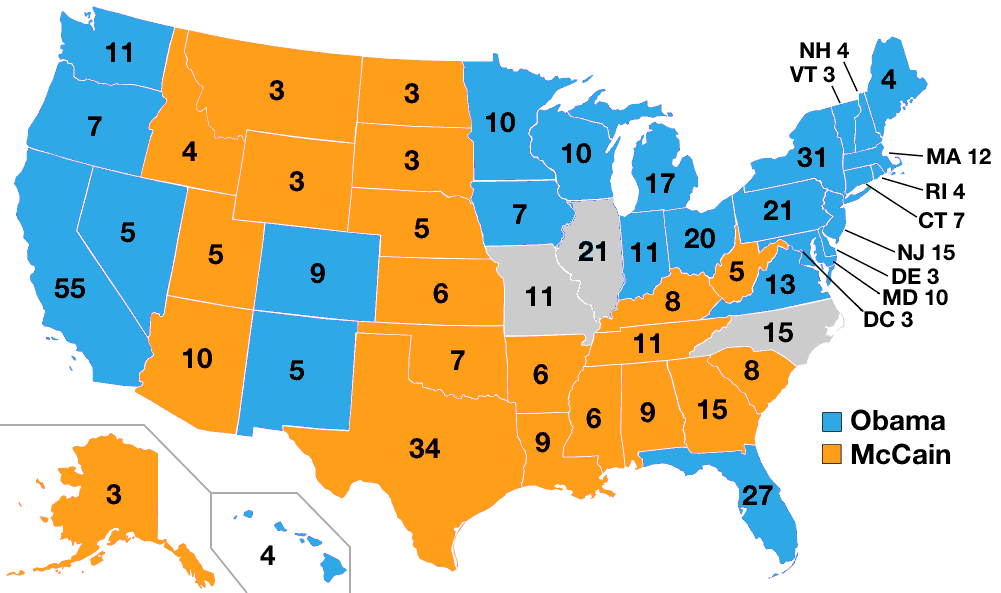
Each state gets electors through a set rule. It gets one for each House member. It also gets two for its two senators. The National Archives gives this state rule. So the House share varies by state. The Senate share always adds two. Washington, D.C. is not a state. Still, it gets three electors.
Picture chairs around family tables. A large family needs more chairs. Yet each table also gets two fixed seats. The picture is not perfect. Still, it shows how the rule works.
With electoral college explained this way, the map makes more sense. States do not all have the same total. So a win in one state may add many votes. A win in another adds fewer.
These rules set the number of votes before anyone casts a ballot. They build the full group of 538. That is why 270 wins. However, they do not decide who gets the votes. State rules handle that next step.
How states turn the popular vote into electors
Most states use a winner-take-all rule. The vote across the state picks one winner. That candidate gets all of the state’s electors. A small win and a large win give the same result.
Maine and Nebraska use a different plan. Their rules can split their electors. Think of most states as placing one full order. Those two states may split the order into bags.
State law sets how each state awards electors. No U.S. law forces electors to vote as the voters chose. The Constitution does not either. Still, states may make electors follow the state result. The National Archives FAQ explains these state powers.
This adds one more layer to electoral college explained. Voters take part on Election Day. Then state rules guide what happens next. In most places, the state winner gets every elector. State law may also bind them. So the state result matters more than one big sum. Yet those electors do not meet on election night. Their work takes place weeks later.
Electoral college explained: what happens after Election Day
Election Day starts the count, but it does not finish it. Electors meet in their own states in December. The date is the first Tuesday after the second Wednesday. For example, it was December 17 in 2024. The National Archives lists this timing. At these meetings, electors vote for both offices.
The states send the results on. Congress counts them in early January. Then the new terms begin on January 20.
The Electoral Count Reform Act became law in 2022. It added clear rules for this stage. States must issue papers that name their electors. Those papers are due at least six days before the electors meet.
A January objection to the count must meet strict rules. It needs written backing from one-fifth of the Senate. It also needs one-fifth of the House. Only two reasons are allowed. One says the electors were not lawfully approved. The other says their votes were not given the right way. Both chambers must agree before any votes are thrown out.
What if nobody gets 270?

Most of the time, a candidate wins by reaching 270. But no one may reach that mark. In that case, Congress picks both top offices. First, the House chooses the president. Then the Senate chooses the vice president.
The House picks from the top three. Each state’s House group gets one vote. So members act as one state team. A choice needs 26 state votes to win.
The Senate uses a different rule. It picks from the top two. Each senator gets one vote. A choice needs 51 votes. The National Archives describes both backup paths.
Picture a game that ends with no winner. The game then moves to its written tie rules. The House and the Senate each have their own job there.
This backup path belongs in electoral college explained. It shows why 270 is more than a campaign goal. The mark decides whether Congress must step in. That is why news reports track 270 so closely.
Electoral college explained: both sides and the big picture
Supporters say states need a clear role in each race. They also say candidates must seek support in many states. Critics focus on the popular vote across the country. It can point another way. Critics also question the winner-take-all rule. Alexander Hamilton wrote about the design in Federalist No. 68, as the National Archives notes.
You do not need to take a side. It helps to know where the two views split. One side gives more weight to states. The other gives more weight to each voter.
Now picture the same viewer at home again. First, you vote in your state. Then the state result guides its electors. The electors meet in December. Congress counts in January. New terms begin on January 20. Without 270, the House and Senate take over.
Save this guide for the next race. With electoral college explained in plain words, 270 becomes clear. For more politics background, read our guides on the Israel-Hamas conflict and the war in Ukraine.
Frequently asked questions
There are 538 electors, and 270 is more than half. A candidate with 270 has enough votes to win. If no one reaches it, Congress uses the backup path.
Yes, that result is possible. States award electors through their own results. Most give the whole group to one winner. So the popular vote across the country does not pick the winner.
No federal law sets that rule for all electors. Yet states decide how electors are awarded. They may require electors to follow the state result.
No. The 2026 midterm elections were held on November 3. They choose members of Congress and other offices, not a president. The next race for president comes in 2028.